Recently, the latest series of research achievements by Associate Professor Tu Shaobo and his collaborators from the College's Optoelectronic Team have been published in prestigious journals such as Angewandte Chemie and Communications Materials.
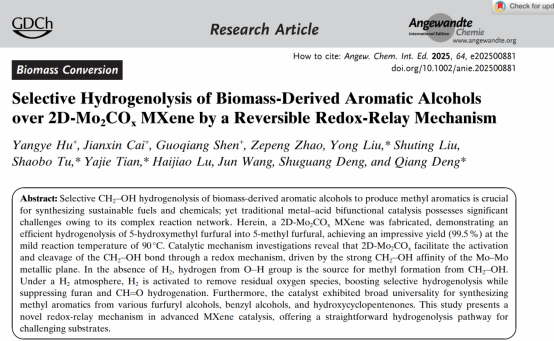
Biomass resource derivatives contain numerous oxygen-containing functional groups (such as C-OH, C="O, C-O-C), and metal-acid synergistic catalysis for hydrogenolysis is a crucial approach to convert them into high-value-added chemical products. However, traditional catalysts exhibit poor synergistic efficiency, low reaction activity, and poor product selectivity. Associate Professor Shaobo Tu, in collaboration with Associate Professor Qiang Deng and Professor Yong Liu from our university, discovered that Mo2C MXene possesses both the ability to activate H2 and selectively adsorb C-OH, efficiently catalyzing the hydrogenolysis reaction of furan alcohol under mild conditions. The relevant research results were published in the Top journal Angew. Chem. Int. Ed. (2025, 64, e202500881).
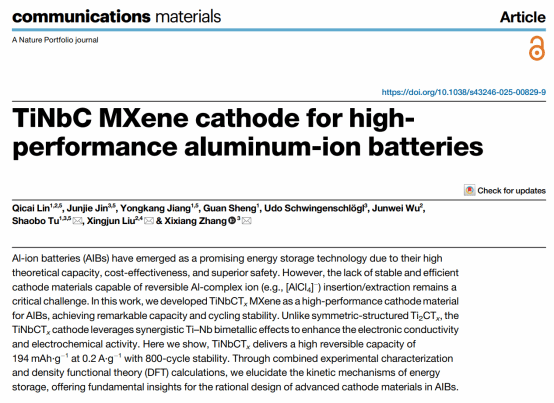
Aluminum-ion batteries (AIBs) have emerged as a highly promising energy storage technology due to their high theoretical capacity, cost-effectiveness, and excellent safety. However, there is still a critical lack of stable and efficient cathode materials capable of reversibly intercalating/deintercalating aluminum complex ions (such as [AlCl₄]⁻). This key issue urgently needs to be addressed. Associate Professor Shaobo Tu, Professor Xingjun Liu from Harbin Institute of Technology (Shenzhen), and Professor Xixiang Zhang from King Abdullah University of Science and Technology have collaborated to develop TiNbCTx MXene as a high-performance cathode material for aluminum-ion batteries. It exhibits a high reversible capacity of 194 mAh·g⁻¹ at a current density of 0.2 A·g⁻¹ and can stably cycle for 800 times. The relevant research results have been published in Communications Materials (2025, 6, 113), a top-tier journal of the Chinese Academy of Sciences.
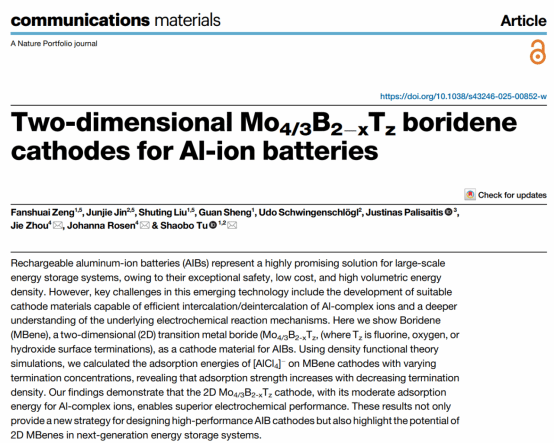
Associate Professor Tu Shaobo also collaborated with Professor Johanna Rosen and Professor Zhou Jie from Linköping University, Sweden, to first use two-dimensional transition metal borides (Boridene, with the chemical formula Mo4/3B2-xTz, where Tz represents fluorine, oxygen, or hydroxyl surface terminals) as cathode materials for aluminum-ion batteries. Through density functional theory simulations, the adsorption energy of [AlCl4]⁻ on MBene cathodes with different terminal concentrations was calculated, revealing that the two-dimensional Mo4/3B2-xTz cathode with moderate aluminum complex ion adsorption energy exhibits excellent electrochemical performance. The relevant research results were published in Communications Materials (2025, 6, 126), a top-tier journal of the Chinese Academy of Sciences.
Associate Professor Tu Shaobo focuses on the design and synthesis of MXene materials and their applications in fields such as energy storage catalysis. As the corresponding author/first author, he has published over 20 SCI academic papers in prestigious journals such as Advanced Materials, Angewandte Chemie, ACS Nano, Advanced Functional Materials, Commun. Mater., Energy Environ. Mater., and Nano Energy.


 CHN
CHN