Current commercial lithium-ion batteries with liquid electrolytes suffer from safety hazards such as spontaneous combustion and fire. Replacing conventional liquid electrolytes with non-flammable solid electrolytes is widely recognized as a key research direction for next-generation high-safety lithium batteries. Among various solid electrolytes, polymer electrolytes stand out as a research hotspot with promising industrialization prospects, owing to their excellent film-forming ability, favorable flexibility, controllable cost, and good compatibility with existing battery production lines. Nevertheless, this type of electrolyte is plagued by severe interfacial side reactions, low room-temperature ionic conductivity and insufficient mechanical properties, which remain major bottlenecks hindering its large-scale commercialization.
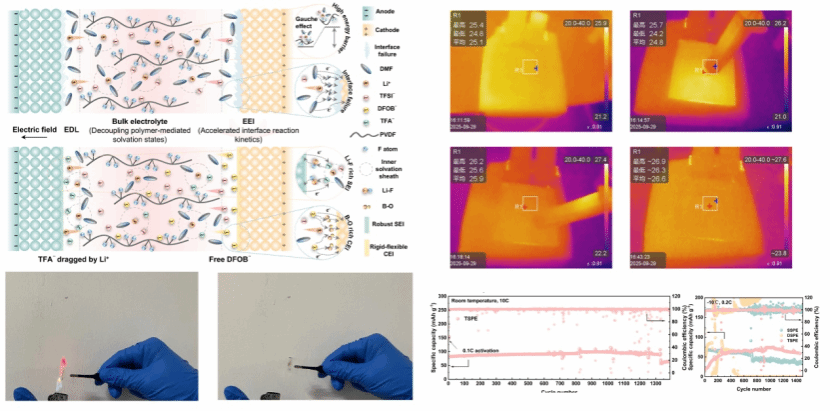
To tackle these critical industrial challenges, the research team led by Professor Wang Li and Associate Professor Hu Zhengguang from our college has carried out systematic research on poly(vinylidene fluoride)-based polymer solid electrolytes. By precisely tuning the composition and ratio of composite fillers and rationally designing functional additives that effectively suppress interfacial side reactions, the team has substantially improved the interfacial stability and ionic transport capacity of the polymer solid electrolytes. Polymer solid-state batteries fabricated based on this technology deliver outstanding electrochemical performance and wide-temperature-range adaptability: they maintain a capacity retention of 78.98% after 1000 consecutive cycles at a high rate of 10 C at room temperature, and can operate stably over a broad temperature window from −10 °C to 80 °C. The team further assembled solid-state pouch cells, which successfully passed rigorous safety tests including nail penetration, extrusion and thermal runaway tests. These results demonstrate the superior safety of this system and offer a feasible technical route for the large-scale engineering application of solid-state lithium metal batteries.
A series of related research findings have been published consecutively in top international journals in the field of energy materials, including Energy Storage Materials (IF=19.3), Nano Energy (IF=16.7), Small (IF=11.9), and Journal of Colloid and Interface Science (IF=9.6), attracting attention from peer researchers worldwide.


 CHN