Recently, Professor Shu Fuwen's team at our college has made significant progress in the research on inflation and primordial black holes in the very early universe. The team published an academic paper titled "Primordial black holes with anisotropic hair" in the form of a Letter in the Nature Index journal Physical Review D. This study, by investigating an anisotropic inflation model coupled with a vector field, is the first to explore the formation of primordial black holes with statistical anisotropy. Chen Chongbin, a postdoctoral fellow at our college, is the first author of this paper, An Baixin, a master's student, is the second author, and Professor Shu Fuwen is the sole corresponding author. Nanchang University is the sole corresponding institution. This research work has received project support from the National Natural Science Foundation of China and the Science and Technology Department of Jiangxi Province.
Inflation is a theoretical framework that addresses the issues of the Big Bang model. However, our current understanding of the microscopic physics of inflation remains limited. Studying the behavior and interactions of early fields is crucial for understanding the very early universe and the physics of particle physics at high energy scales. The enhancement of curvature power spectrum during inflation can lead to the formation of primordial black holes and the generation of scalar-induced gravitational waves. Primordial black holes are a candidate for dark matter and play a significant role in cosmic evolution. Meanwhile, thanks to the advancements in gravitational wave detection over the past decade, we can also utilize the stochastic gravitational wave background as a probe of the early universe.
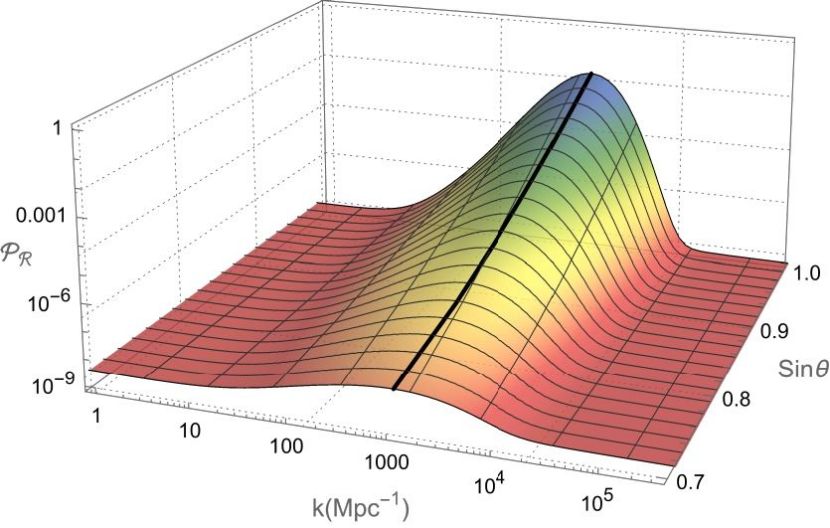
Figure: Power spectrum enhancement degree relative to the change in vector field direction
This study explores the contribution of vector field perturbations to the curvature power spectrum in anisotropic inflation models. By breaking conformal coupling, the vector field can remain undecayed during the inflationary phase, and the vector field perturbations mix with the inflationary field perturbations. One can only calculate this using perturbation expansion under weak mixing. This study analytically investigates the dynamics of vector field perturbations in the case of strong mixing for the first time and finds that these perturbations undergo exponential growth when crossing the cosmological horizon. This enhancement can serve as a new mechanism for the formation of primordial black holes, leaving behind vector field-specific anisotropic features in primordial black holes and induced gravitational waves. Searching for such vector features through the stochastic gravitational wave background can provide a new way to test the cosmic no-hair theorem.


 CHN
CHN