University News (School of Physics and Materials Science)
Recently, the joint research team from the School of Physics and Materials Science and the School of Information Engineering of our university has published its latest research findings in Optica, the flagship journal of the Optical Society of America. Titled “Integrated spectropolarimeter by metasurface-based diffractive optical networks”, the study innovatively proposes an integrated spectral-polarization sensor based on metasurface diffractive optical networks. Capable of simultaneously measuring spectral and polarization information within a single microscale device, this design blazes a new trail for the miniaturization and integration of multidimensional optical sensing technologies.

Traditional spectrometers and polarimeters generally rely on bulky discrete optical components, which not only hinder integration but also fail to capture spectral and polarization information simultaneously. Rooted in the interdisciplinary integration of nanophotonics, artificial intelligence and optical engineering, our research team adopts a co-design strategy combining metasurface photonic devices with deep learning algorithms. By integrating the core functions of spectral analysis and polarization measurement onto a single chip, the team has broken through the key bottlenecks of limited functionality and poor integration capability inherent in conventional optical systems.
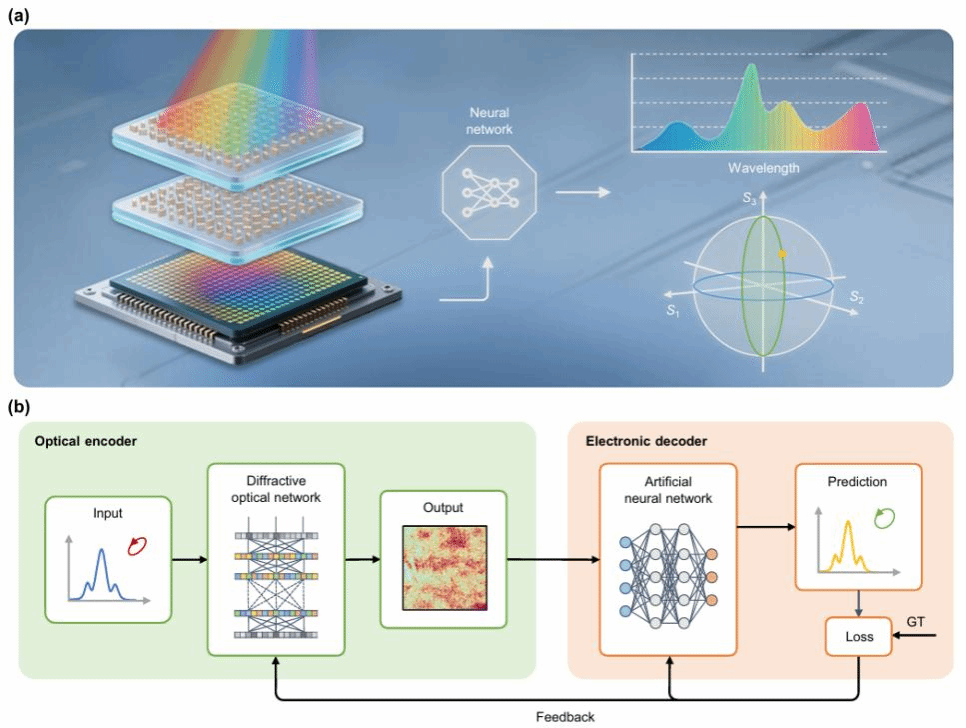
Through wavelength- and polarization-dependent phase modulation enabled by metasurfaces, the system encodes optical information into spatial intensity distributions, which are subsequently decoded by neural networks. This allows high-precision reconstruction of spectra and full Stokes polarization parameters with only a single snapshot. Experimental results validate the device’s broadband and high-fidelity detection performance in the near-infrared band. To further verify its practicality, the research team integrated the metasurface encoder onto the pixel array of a commercial CMOS image sensor and developed a chip-scale integrated sensor prototype. The overall sensor is comparable in size to conventional imaging chips, requiring no moving parts or discrete optical components, and thereby realizing single-shot multidimensional information acquisition.
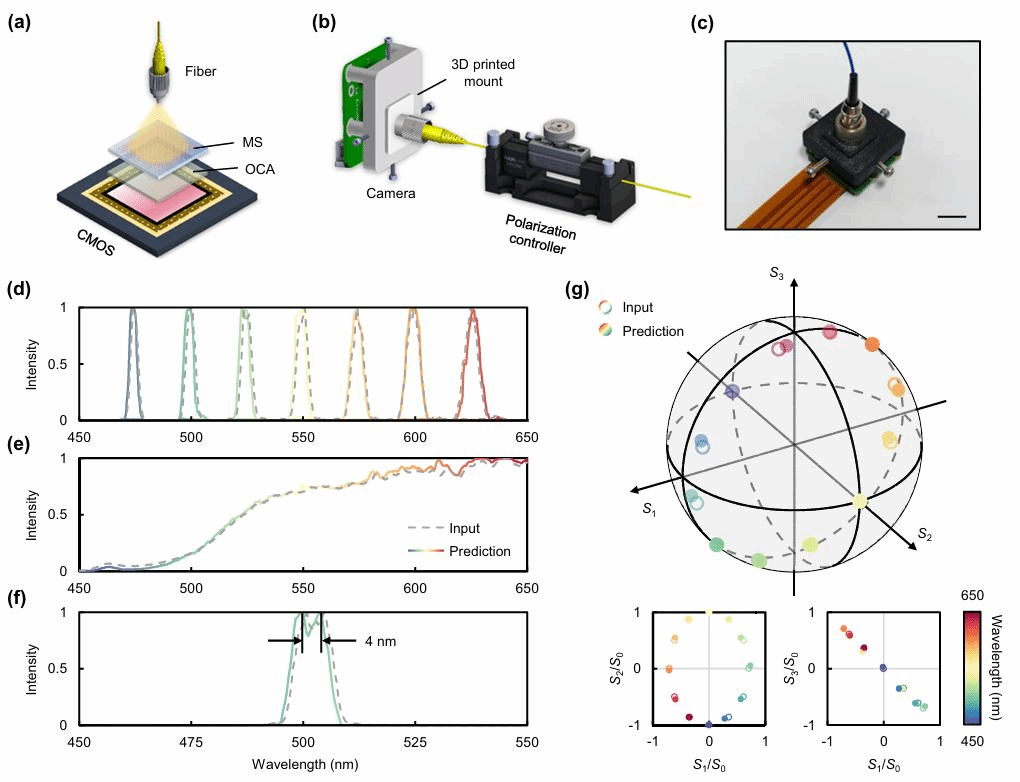
The core innovation of this research lies in the collaborative optimization of physically driven metasurface design and data-driven deep learning, enabling the system to tailor the optical field distribution in a manner optimal for subsequent recognition. This end-to-end co-design approach provides a theoretical and practical framework for the development of multifunctional, ultra-compact optical sensors. The relevant technologies hold promising application prospects in various fields, including biomedical diagnosis, industrial inspection, environmental monitoring and machine vision.
Qiu Jumin, a doctoral student from the School of Physics and Materials, serves as the first author of the paper. Professor Yu Tianbao from the School of Physics and Materials, together with Professor Liu Qiegen and Associate Researcher Xiao Shuyuan from the School of Information Engineering, are the co-corresponding authors. Nanchang University is the sole completion unit of this research. The study was supported by the National Natural Science Foundation of China, the Natural Science Foundation of Jiangxi Province, and relevant talent programs in Jiangxi Province.
Paper Link: https://doi.org/10.1364/OPTICA.583686
Reviewed by: Xu Hang, Tu Jinfeng, Zhu Wenfang, Chen Xiaochi


 CHN
CHN